What I learned at one of the biggest writer conferences
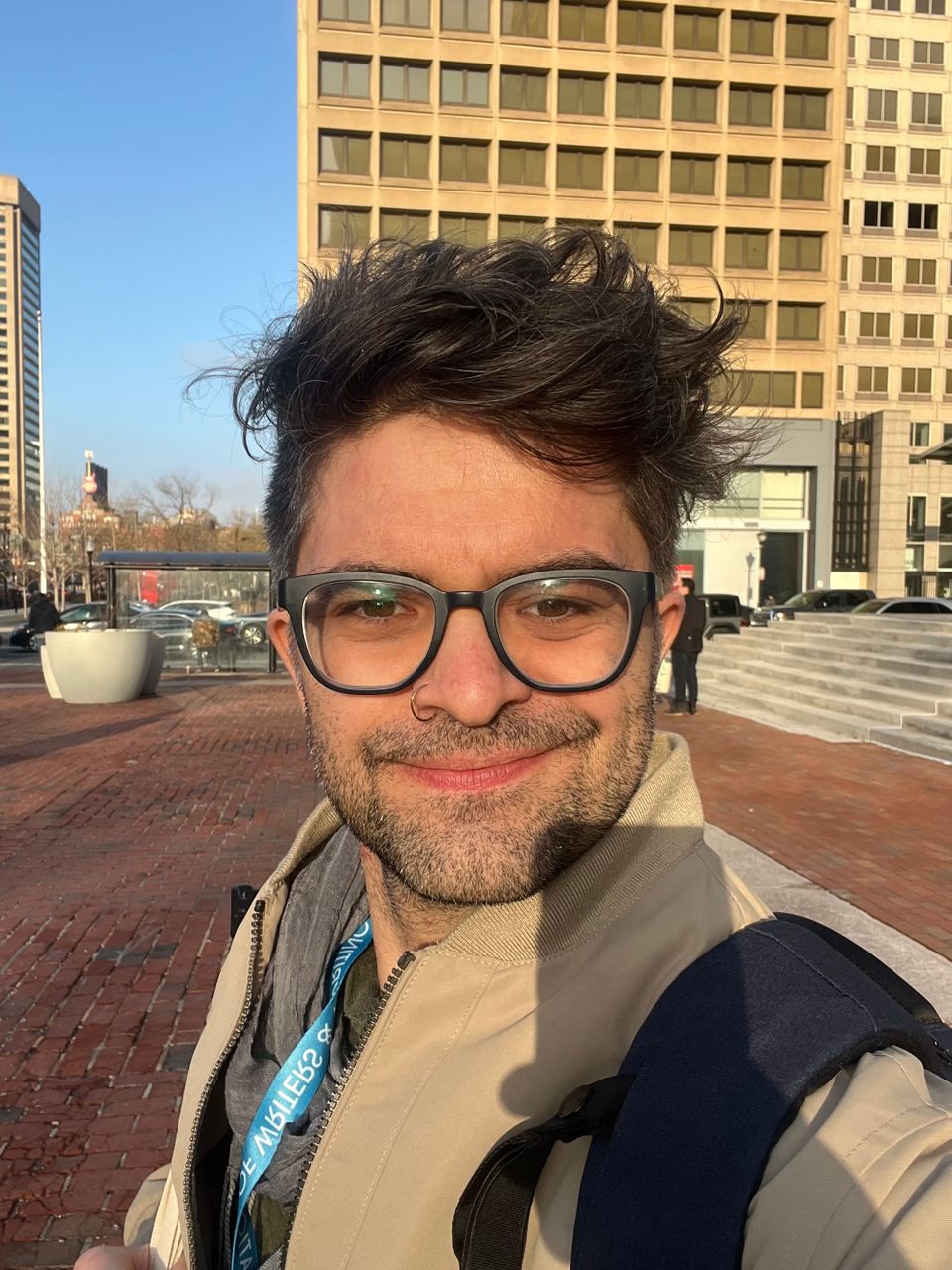
Today's note is on 2026 AWP in Baltimore, Maryland.
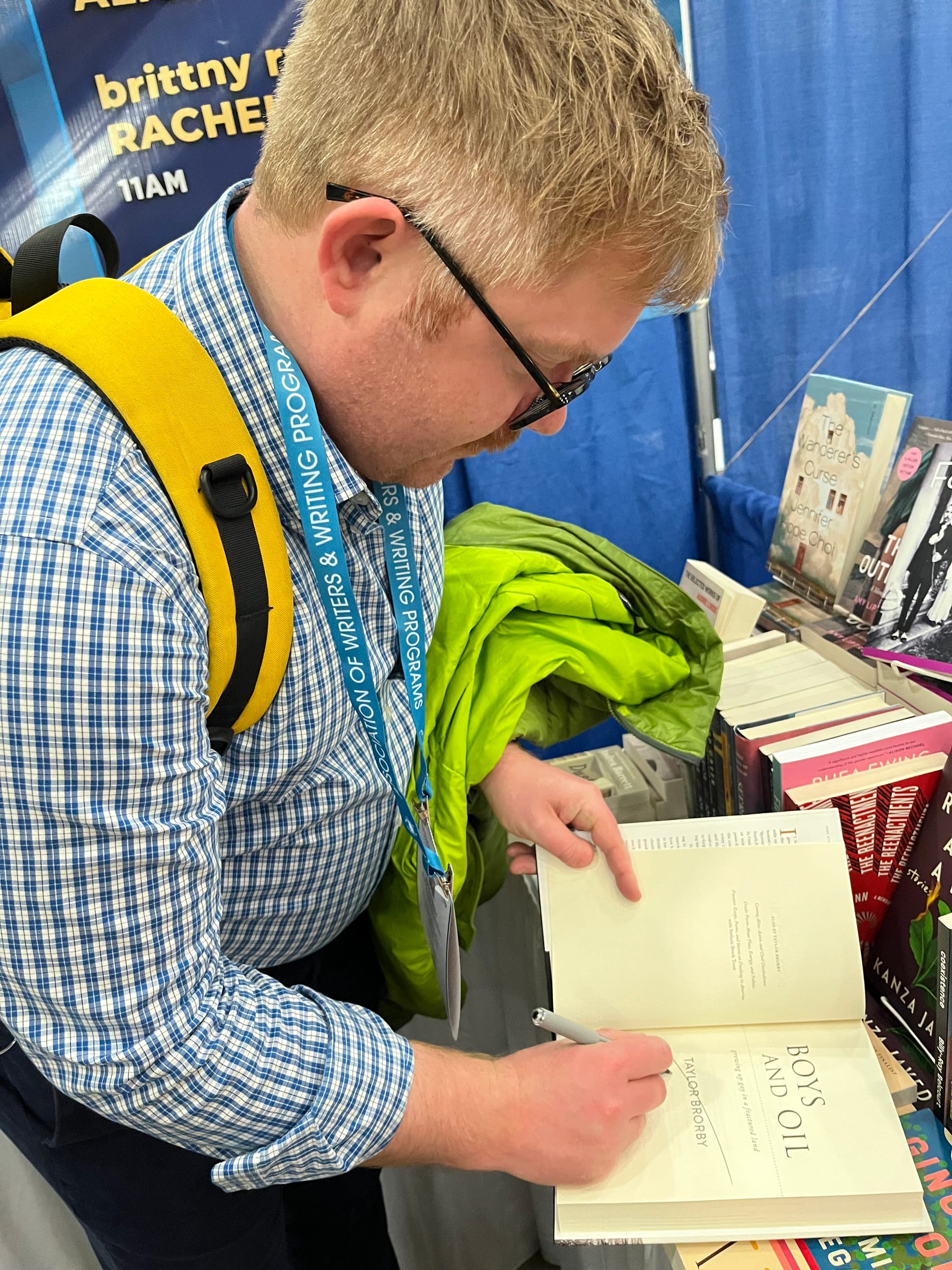
This year, I went to AWP – the Association of Writing and Writing Programs – for the first time. I finally made it. I'm giving lots of credit here to my good friend Taylor Brorby, the brilliant writer from North Dakota. He encouraged me to go. He served as a liaison for my time there. You all should read him, follow him.
This year it took place in Baltimore in the heart of downtown. Traffic, blocks of buildings and windows, behemoth hotels, chain restaurants, cigarette smoke, cobble stones, monuments and flag poles; fog painted skies and concrete; crab-themed pubs and diners, the constant drone of traffic that whizzed by in clouds of underground steam that fluffed out like toy tongues; All in the orbit of the conference were tourist magnets such as old ships, a national aquarium, and a Hard Rock Cafe.
But all that was on the outside of the conference, and created the conditions for a workout. Attending AWP is physically a challenge. Every block studded with a stoplight. You are forced to stop frequently when walking around. Lots of elevators and escalators and lines. I hauled books, snacks, notebooks, water, a laptop all over the that place. My feet hurt, my shoulders drained, but I feel stronger. Lots of hills, too, if you go walk a mile or so in any direction to attend a party, go to dinner. I can still feel the all the steps swirled on my feet, deep in my muscle. It's delightful.
The experience of AWP itself is a speedboat of an event: meals, book fair, panels, readings, parties. Sleep for a sec and repeat.
One other thing I'll say is AWP created an inner light-bulb joy within me. It was wonderful to be around thousands of writers. A sense of style with unique pants, scarfs, glasses, belts, totes, dyed hair, dresses, suits, sun-flower yellow to diamond glitz. There was a real sense of love for the written word, a joy for making art, community, and humanity.
So, like a true nerd, I went to many panels. Here's the resources and things I learned. Here, too, are the thoughts that lit up my mind like quiet candles.
Podcasting is part of literature and the moon can be your editor
Some of my favorite panels acknowledged the digital. Some panels seemed to forget that digital is part of literature, a part of the writing and the book world.
What stood out to me were two panels that addressed podcasting's role in literature.
First, the delightful Amanda Montell, host of the award winning and joyride-of-a-podcast, "Sounds like a Cult" lead a panel "From Page to Podcast: Amplify Your Writing Career on the Mic." This featured writers and podcasters including Amanda's co-host the writer Iman Hariri-Kia, Nora Mclnerny, and Kate Kennedy
All of them talked about – and have proven – that podcasting can be an extension of your writing. It can be a way to reach a larger audience and expand your ideas.
This is why Amanda started Cult: her first book didn't sell as well and didn't get the attention she thought it could have. She started a podcast and the impact was wide – her books were amplified. "I just want to write my books and do my podcast," she told me later when I went up to talk with her for a bit. So everything she does serves those two purposes.
You may not make money off your podcast, but it might help you get your ideas, create community, and be fun. In fact, don't count on it making money, but if you do podcasting for the right reasons, count on it giving you something more than money.
Another theme that emerged in talking about podcasts: the rejection of podcasts's pivot to video. "Things have always been pivoting to video," one of the panelists said, but I can't remember which. You don't need to do video to do a podcast. In fact, all you need is a computer, a RSS feed, a mic, a bit of software. You can do it for relatively cheap. And keeping things auido, you honor one one of the key points of the podcasting medium: looks don't matter. You don't need to look a certain way or feel a camera on your body.
Again, don't do this to make money. Make a podcast to be a companion in someone's ear. Do it because podcasting can feed your writing career.
Other tips for starting a podcast:
- Your podcast idea/concept: What can you talk about for hours on end? What's most interesting? Try doing a 20-30 minute voice memo about that topic. Try that a few times to see if you're cut out for podcasting.
- Tech stuff: Use Libsyn for hosting your pod – to send it out to the apps and create a RSS feed. You can use Descript, Audition, or even Apple's Garage Band to cut and manage the audio. Riverside is what many folks in the industry use to record interviews. But anything could work from Google Meet or Zoom, especially if you're just getting started. You can get a mic that goes straight into you phone if you need (this is how Amanda recorded the first season of Cult). DON'T PAY ANYONE TO LEARN ALL THIS. You can find all this on the internet. With like a few hundred dollars – or less – you can do this. Message me if you need help.
- Growth: Consistency and don't lie about who you are. Once you're up and going, you can offer to go on other shows, explore other niches, and offer folks from other shows to come onto your show. Know that as of now, on the doorstep of spring 2026, you'll need at least 20k downloads to monetize. At least.
Another panel on podcasting, "A New Sonic Space" featured Trey Burnart Hall and Jessica Nelson from Virginia Commonwealth University. Along with the legend writer and podcaster Carvell Wallace and the wonderful Dawnie Walton from the Ursa Story Company.
This panel focused on how podcasting – audio – can be literature, or add to the form of literature; at least what we traditionally might think of as literature. We may think of podcasting now as a chat show with a nice studio and an HD webcam (a TV show?), but to many it's still a pure audio form with narrative purpose – even if it is an interview.
Carvell Wallace's Pure Ghost Radio, his Substack, is an example of this. They are personal audio essays that meander and muse – that often include comes music. They come out every full moon, roughly. "The audio version of taking a walk because you can't sleep," is the tagline.
Carvell called the moon his editor. When he sees it waxing, getting closer to full, he starts to say to himself. "Shiiiit, I don't know what I am going to write for this month!" He monetizes his publications, but doesn't make a living on just writing Pure Ghost Radio. "The things I like doing the least make me the most money," he said. But that makes it different – he loves to do it. Taking money out of it makes it easier to do – there is a different kind of effort put into a thing when it's not the primary source of paying for food and shelter.
Dawnie also mentioned that her podcasts that feature underrepresented voices in the publishing and writing world are a passion project. (I recommend the Business of Publishing, but all of their pods are great.)
Trey, a folk artist, brings music into his podcasts and interviewed his neighbors, and looked at the power of archiving someone's voice – another globular beauty about podcasting and audio.
All in all, you can use audio to do the project of literature. To help us understand what it means to be a person and record what it means to live in the world.
One last thing I'll add is Carvell's words: If you want to do something – like start a podcast – there are often two routes people take.
One, you say, "will I do it?" Or, two, you say, "I need a grown up who will let me do it." Many people seek a grownup – an authority to tell them they can do something.
There aren't really that many grown ups, really, Carvell said. So you mind as well do it.
Will A.I. replace the writer?
A big-ticket panel was on the top floor of the conference center – four stories up. With a full wall of windows, it felt like I was on top of a cruise ship rigidly planted in downtown Baltimore. I got up there well before the reading. There was less foot traffic up here, less human voice, less exchange of commerce and ideas. It was largely blank and empty, sound was swallowed into the carpet; only a humming escalator in the back, the cough of someone by themselves at a faraway table. The empty pillars invited a human back to lean against it with a laptop and notebook to write and think.
I indeed posted up on one of these pillars when one of the panelists, Ken Liu, the sci-fi/fantasy wonder writer, walked right by me with his messenger bag. He shuffled from one window to the next looking out. I had just bought his latest book earlier that day. It was in my bag as he walked past me, I saw his name on his conference badge.
I could have said something, but I figured he wanted to be alone before being rushed by a crush of people; being asked for quotes from PR and social folks. I now regret not saying something like, "looking forward to reading your book." Oh well. His mind is an amusement park – deep thinker in technology, Harvard-trained lawyer, and brilliant heart-felt, action-packed fiction.
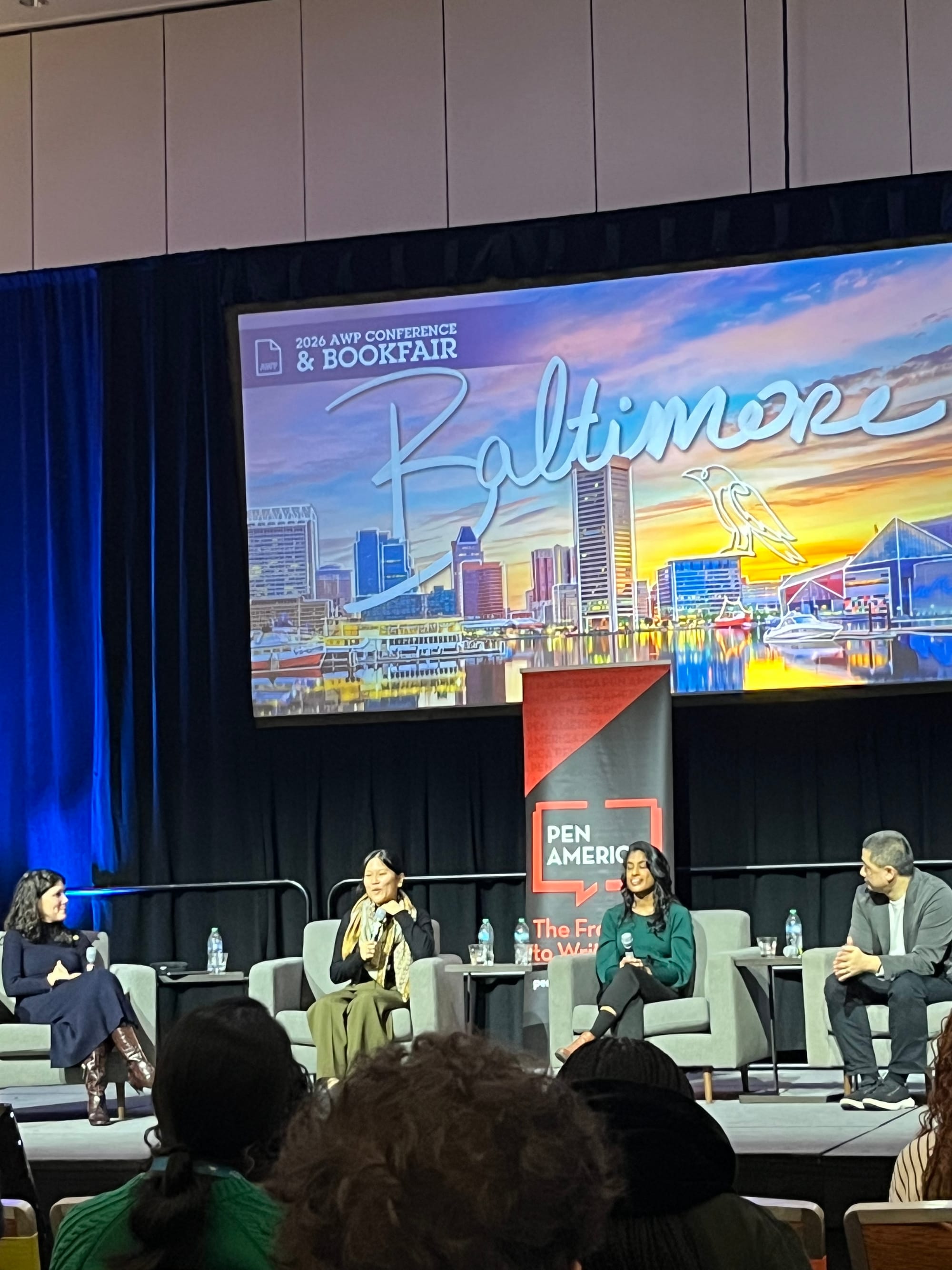
The room for the talk was big with lounge chairs on stage, multi-screens, production crews with head mics who blew the steam off over-cooked coffee. Spaced out chairs, nice lighting and airy. Here was the Pen America's sponsored panel, "Art Under Threat? The Impact of AI on Creative Writing."
The panel featured splashy tech journalists Karen Hao and Vauhini Vara, alongside Ken Liu. I was excited to be here and hear an intelligent talk about one of the largest topics in the literary (the whole?) world: what to do with A.I.?
A.I. was largely a hated technology among creative writers. To many writers, my feeling was, it felt like something so powerful folks largely ignored it, or leaned on cliches descriptions – simple arguments of dislike and dismissal.
Let's get the big question out of the way: "Do I think there will be a Robo-Ken that will write all my future books?" Ken asked rhetorically at one point. "No, absolutely not." It felt as if every writer took a breath throughout the crowd and clapped when Ken was done talking. He said several times and punctuated with, "let me go on record," he doesn't think this technology will replace the writer, the novelist, the creative writer. "Art is for people made by other people." All creative writers of all aspiration sizes again breathed. I did, at least.
"This technology isn't that interesting when it generates text," Ken said. That generation is always based on a past, and especially if you're using a commercial model, is based on particular rules – told to speak a particular way. The goal of a writer, in Ken's words, is to invent a new language – find a new way – to say something. Find a new way to tell the story.
Emily Wilson's translation of The Odyssey is an example Ken brought up. Wilson, the first woman to translate the epic poem, was also the first to use the word, "rape" to describe a particular scene with enslaved women. She also dropped misogynistic language such as "whore" and "slut" that had often been used by past translators, even when the original text doesn't have those words. By doing this, Wilson found (or recognized) a new way to tell an ancient story – and we, the culture, are better for it. An LLM based on all our past, all our past translations of The Odyssey, wouldn't have given the text the rigor and imaginative power that Wilson did.
Creative writers are inventors of worlds and frameworks. They can open a new way of feeling – a new way of exploring images and dreams. When you write, you find a new way to speak to something. Whether it be grief, family, nationhood, love, machines, God, or any other part of humanity.
Liu brought up the thoughtful point that A.I. chatbots, LLMs, may end up doing something like the camera did for middle class families in the 20th century: it created a whole way of recording the family portrait, of recording lives, in a way that was too expensive before with the hiring of a painter.
In a similar way, people may ask an LLM for a personalized novel for one, a novel that's so specific it only means something to one person – not that dissimilar to a selfie or a family portrait. You may even create a A.I.-generated novel that is a bestseller, "but that isn't art," Ken said.
Ken also advocated for a more nuanced framework and respect for this technology – it's not something to be dismissed. "We are technology," he reminded us. We, human beings, aren't separate from tech – we're intermeshed. Rather than being claimed as the devil, LLMs are instead "a wonder."
How the LLM came to be is a remarkable thing: built on transformer technology that took years to build. A technology doused in human language – much of the internet – and that can respond to nearly any question prompted in a textbox. This is astounding, but its sole purpose is not to create fully formed novels, or art. Instead, we may be able to do something else interesting with this LLMs.
For example, after going through writing crisis during the pandemic, Ken built his own machine learning model where he trained the model just on his own fiction writing. As a former lawyer who understand copyright, he left the rest of the Internet out of it. This was interesting, he told another interviewer, but the answers from his A.I. had to often be finished by him. Ironically, he had to make the results from the A.I. sound more like a machine.
The chatbot didn't really help him write, but it did show him a way to look at his writing and how to look for patterns and tendencies. The results from A.I. can be used to study human language – it's a collective map; a way to connect ideas, perhaps, or reveal them. A model based on your own writing may be able to point out inherent bias, unwanted patterns, or redundancies. To use a language model in this way, gives you more control and scope.
When it comes to control – as Karen Hao and Vauhini Vara brought up – when someone uses the big models of OpenAI, Google, Anthropic, these giant corporations are the ones in control of how the model is used and responds, how they shape answers, and how to use the vast data within the models. And depending on your perspective, used much of the internet (and beyond) to train their models without the permission of the writers and creators.
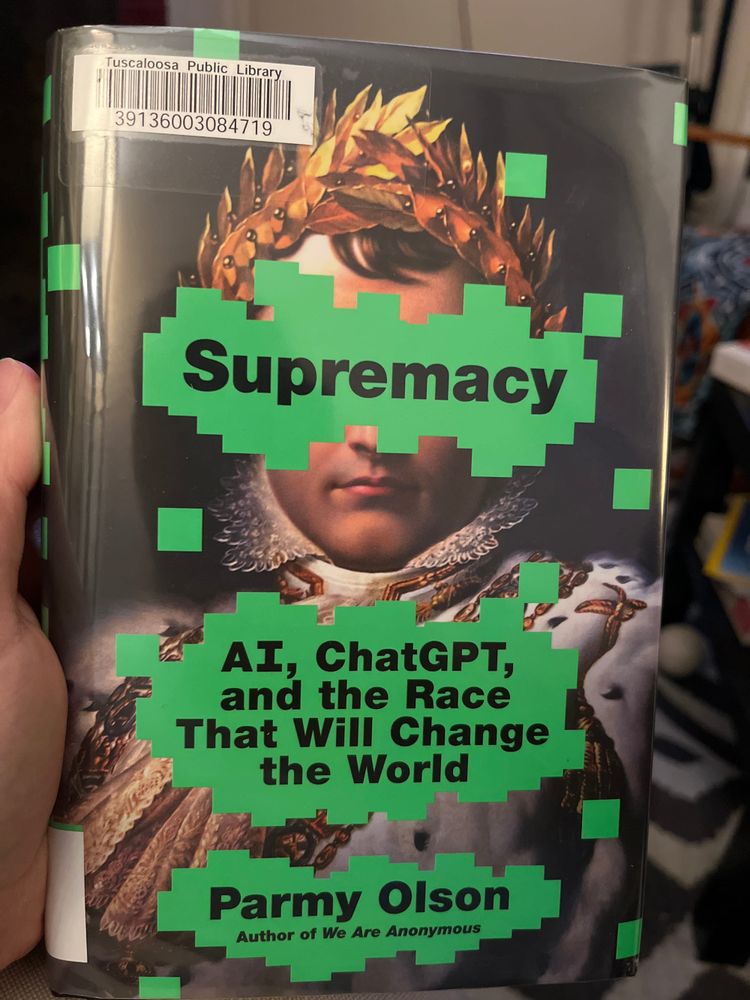
Borrowing Karen's powerful metaphor, the A.I. giants are more like empires than benevolent companies looking to improve life on earth. The models exploit resources – environmental and human; with the exploiting often taking place far away from the Silicon Valley. The leaders of this technology – a single group of people – claim this technology will educate and give billions of people tools to thrive – an imperial idea: one tool or standard education is the way to uplift in society. Like empire, they push out the use of the technology for military operations across the globe. There is also the worship-like rhetoric that this tech will save us – and it's magical properties will deliver world-saving solutions. Because of the money and speed, the tech has an element of invasiveness in many of our digital infrastructures without permission – my plumber for example used a virtual assistant to take customer service calls. And like ships of old, there are the bots scraping and taking of intellectual resource without permission.
Even if you avoid the empire, writers still must contend with A.I. for it can impact writing even if you don't use it. A.I. makes us think: does this sound like A.I.? Can I use the an em dash? Can I use a bullet point? A.I. writing, the presence of its output, is there. I even feel like I am not writing fast enough because I know an A.I. model has generated miles of text before I can finish two paragraphs. For me, the temptation to use an A.I. is there – to speed an idea along, to whip through some edits. But A.I. isn't a great enemy, the tech isn't the enemy. I'm with Ken, the details matter a great deal. We need to be more precise when we talk about dealing with A.I.
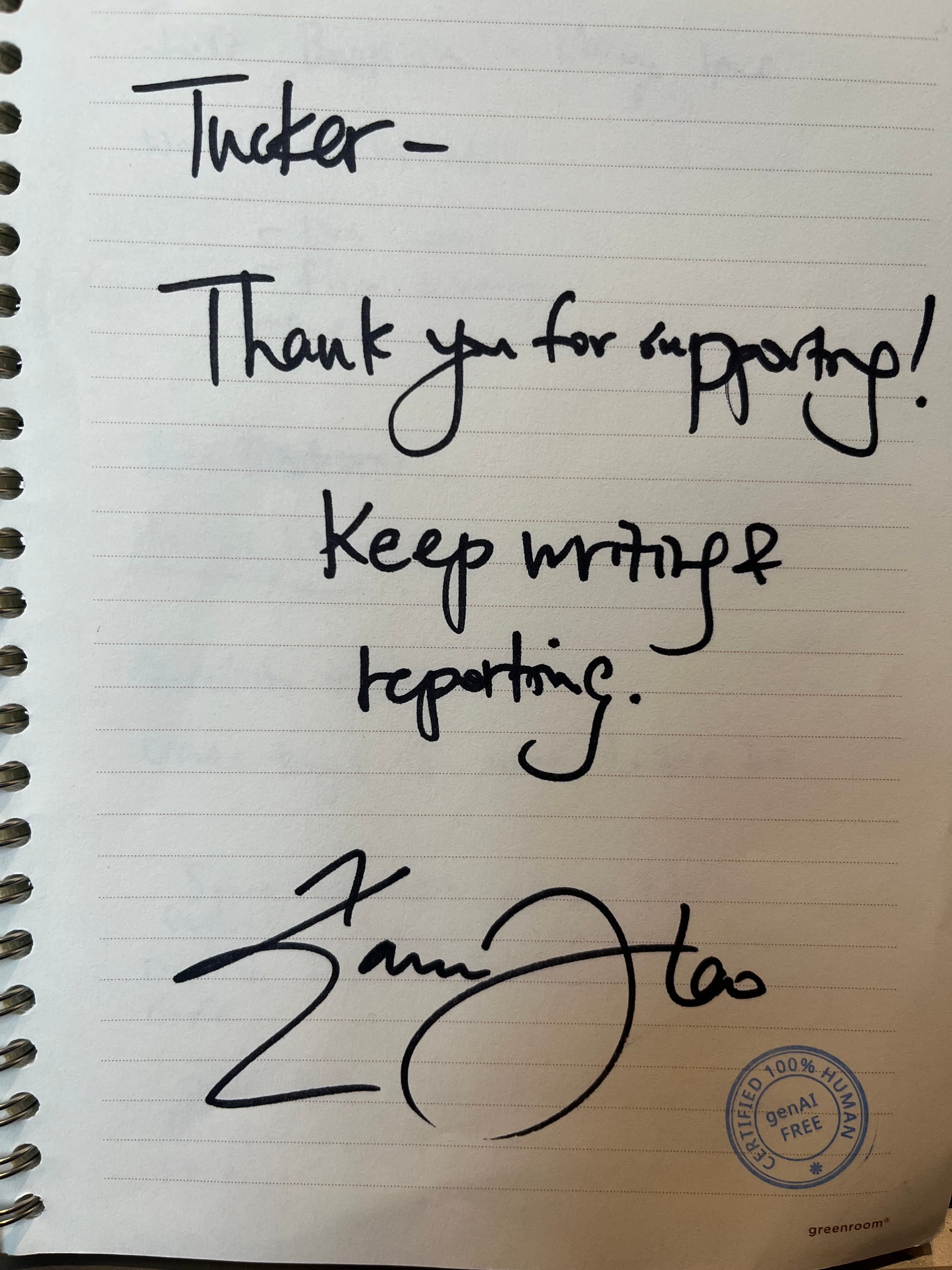
Another reason, writers mustn't worry: A.I. knows a lot, but it doesn't know everything you keep silent. Models don't know what you don't say – the thousands of words and feelings you, the writer, don't write down or share. Think about what you don't say when you talk to someone.
It can't know you – or your inner life. That is what art, what writing is about: to examine and study feelings, to engage with our myths, tropes – to travel within, in the loam of the soul and try to figure something out.
A.I. is a desire fulfilling machine. When people ask the bot for answers, people are searching for something. They want to be understood. This is a human need. To be understood. To be recognized. Listened to. Seen. Novels, books, stories can be a craft to help us understand a part of what it means to be human, and to build a connection – to escape boredom. You're not an artist when you ask for a novel from a chatbot. You aren't practicing craft – even if you're seeking to fill the same desire.
Other odds and ends from the conference
Here's a list of other resources and stuff I ran into at AWP. They might be helpful if you're into writing and reading.
- Alex Hanna – fighting A.I. hype.
- Zona Motel. This quirky and lively publication is taking back the fun in writing and looking to smash gatekeeping. It's wonderful. I went their event at Le Mondo, and it was a blast. If you're in Baltimore, you should go. To get a taste of Zona, see their manifesto:
ZONA MOTEL exists not just as a publication but as a BROTHERHOOD. This Brotherhood has been established as a countermeasure to the current State of writing, publishing, and Existence. We have created this BROTHERHOOD and WEB SPACE, ZONA MOTEL, to envision a literary World where things feel exciting, inspiring, and fun.
- Write that damn book already by Elizabeth Lyons
- If you need help on the business end of writing: Jane Friedman is the person to read. Kathleen Schmidt is also good. Galiot Press provides an alternative model for publishing. Here's another good newsletter on small press publishing. Belt Publishing is other smaller, Rust Belt-based publisher that may be of interest.
- Fractured Atlas – to help make a collective into a non-profit or into a business.
- JustBook-ish
- GrubStreet
- 826Boston
- Pangyrus (they used Fractured Atlas to get funding and move into becoming an official organization)
- We should all probably read Sequoia Nagamatsu. Here are some titles on his dystopian syllabus:
- Blindness
- The Water Nymph
- Ten nights of dreams
- The Genocides
- Everything by Margaret Atwood or anything by J.G. Ballard.
- A Canticle for Leibowitz
- The Light Pirate
- Non-fiction: Palaces for the People: How Social Infrastructure Can Help Fight Inequality, Polarization, and the Decline of Civic Life
- Sequoia said something wonderful at the dystopian panel: "The act of writing is an act of hope." To, if nothing else, leave a record, to leave a connection – to create art for another is a big act of hope.
- The Chicago Book Review – use to find your next read!
- Story Studio Chicago – really helpful for writers and aspiring writers.
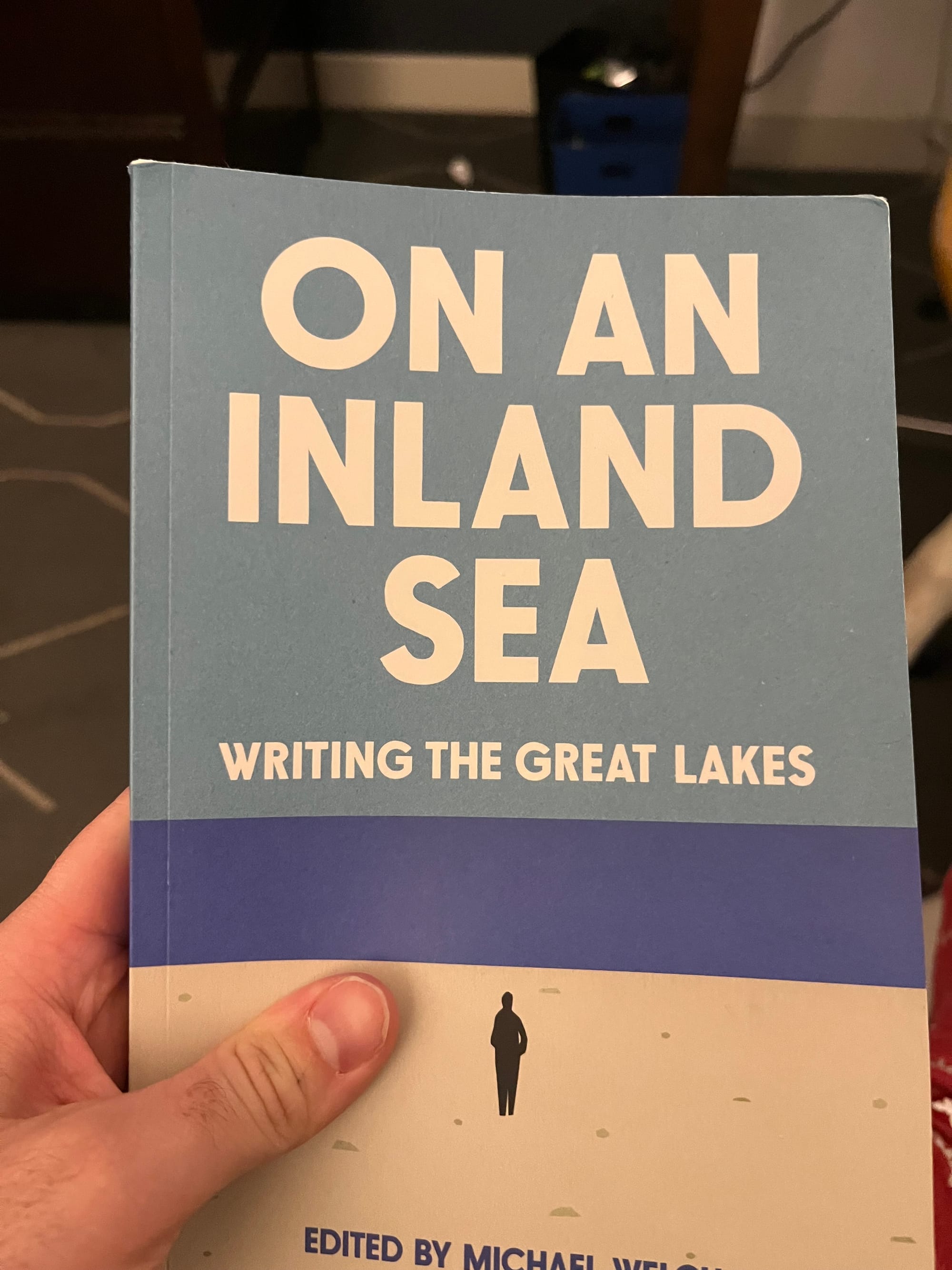
- On An Inland Sea writing the Great Lakes. I'm excited to read this anthology:
- Check out this cool trans and gender poetry press, New Words Press. And this one: a funky, zinger, colorful press called Microcosom.
- See the PDF below for a list of every organization who had a booth at AWP:




Member discussion